
Introduction: The Questions Every IPTV User Is Asking
The rise of internet-based television has brought with it a wave of questions that traditional cable subscribers never had to consider. Chief among them are two that sit at the forefront of every informed consumer’s mind before signing up for any IPTV service: Is it legal? And is it safe? These are not paranoid questions — they are responsible ones. As Krooz TV and services like it have grown in popularity, so too has the public conversation around the legal and security dimensions of IPTV consumption. The honest answer is that legality and safety in the IPTV space are not black-and-white issues. They exist on a spectrum that depends on the specific provider, the content being accessed, the jurisdiction in which you live, and the way the service is used. Understanding this spectrum is essential for anyone considering Krooz TV or any IPTV platform as part of their home entertainment setup. This article examines the legal framework surrounding IPTV services, the safety considerations every user should be aware of, how to distinguish legitimate providers from problematic ones, and what practical steps you can take to protect yourself as a consumer. By the end, you will have a comprehensive, clear-eyed understanding of exactly where Krooz TV and the broader IPTV industry stand on both fronts.
Understanding IPTV: The Technology Behind the Service
Before addressing legality and safety directly, it is important to establish a clear understanding of what IPTV actually is and how it works — because the technology itself is entirely distinct from the legal or ethical questions surrounding how specific providers use it. IPTV, or Internet Protocol Television, is a method of delivering television content over internet infrastructure rather than through traditional broadcast, cable, or satellite signals. The technology is used by some of the world’s largest and most reputable media companies. Telecommunications giants like AT&T with its DirecTV Stream service, British Telecom with BT TV, and numerous national broadcasters around the world all use IPTV technology to deliver content to their subscribers. When you stream content through an app on your smart TV, you are in many cases using a form of IPTV. The technology is unambiguously legal and widely deployed at an enterprise scale. The legal questions that arise in the IPTV space are not about the technology itself but about what content specific providers are streaming and whether they have obtained the proper rights and licenses to do so. This distinction — between the technology and the content licensing practices of specific providers — is the single most important concept for any IPTV user to understand. Krooz TV, like all IPTV services, operates on the same fundamental technology. The relevant legal question is whether its content distribution practices comply with applicable copyright and broadcasting laws.
Is IPTV Legal? The Framework You Need to Understand
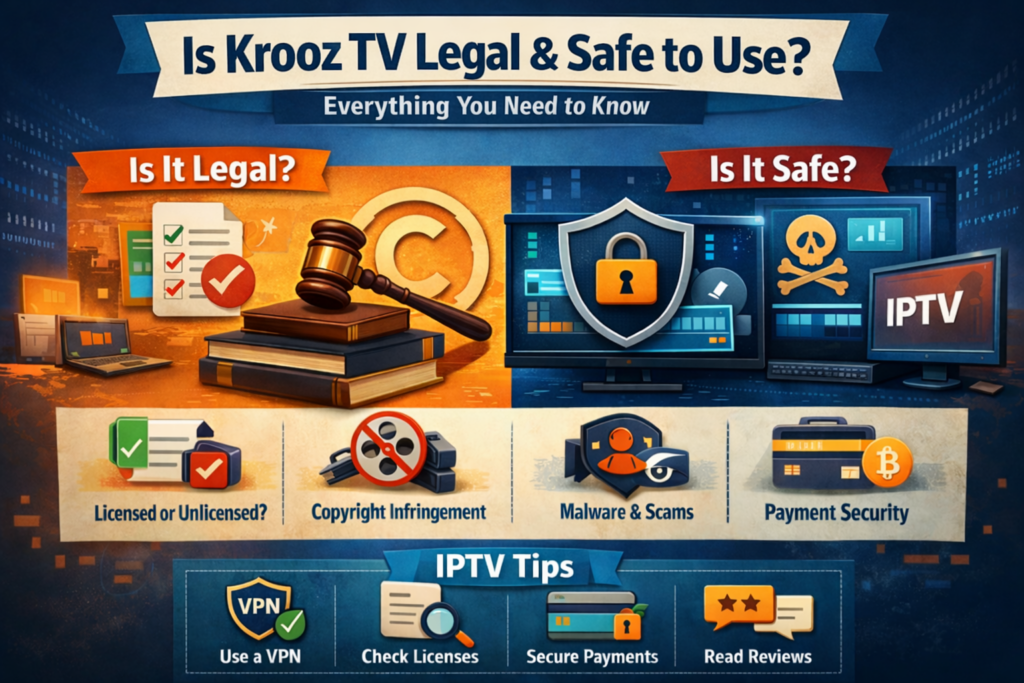
The legality of IPTV services is governed primarily by copyright law and broadcasting regulations, which vary significantly from one country to another. However, several consistent principles apply across most major jurisdictions and provide a reliable framework for evaluating any IPTV provider. Licensed vs. Unlicensed Content Distribution The core legal distinction in the IPTV world is between services that hold proper licensing agreements with content rights holders and those that distribute content without authorization. Licensed IPTV providers have negotiated agreements with broadcasters, studios, sports leagues, and other content owners that grant them the legal right to stream that content to subscribers. These agreements involve royalty payments and are subject to territorial restrictions that determine which content can be offered in which regions. Unlicensed IPTV providers, by contrast, stream content without these agreements — effectively distributing copyrighted material without permission or compensation to rights holders. This practice constitutes copyright infringement under the laws of virtually every country with developed intellectual property frameworks, including the United States, the United Kingdom, the European Union member states, Canada, and Australia. The Legal Status of Krooz TV Evaluating the specific legal status of Krooz TV requires examining its content licensing practices, which prospective subscribers should investigate directly and carefully. As with any IPTV provider operating in this market segment, users are strongly encouraged to verify whether Krooz TV holds appropriate licenses for the content it distributes in their specific region before subscribing. This verification can involve reviewing the provider’s terms of service, checking for official broadcaster partnerships, and researching independent reviews and regulatory actions related to the service. It is worth noting that the IPTV market includes a broad spectrum of providers, ranging from fully licensed, compliant services to clearly unlicensed operations. Many services occupy a gray area where some content is properly licensed and other content is not. This complexity makes due diligence on the part of the consumer especially important. Geographic Variability in IPTV Law The legal treatment of IPTV services varies considerably by jurisdiction. In the United Kingdom, regulatory authorities have taken an increasingly aggressive stance toward unlicensed IPTV, with enforcement actions resulting in criminal prosecutions and significant fines for both operators and, in some cases, users. In the European Union, the Court of Justice has issued rulings that clarify the legal exposure of users who knowingly access copyrighted content through unlicensed streams. In the United States, the Digital Millennium Copyright Act provides the primary legal framework, with civil and criminal liability applying to unauthorized distribution of copyrighted content. For consumers, the key takeaway is that using an unlicensed IPTV service is not a legally risk-free activity in most developed countries, regardless of how normalized it may appear due to the widespread availability of such services. The level of enforcement against end users varies significantly, but the legal risk is real and should be factored into any subscription decision.
Is Krooz TV Safe to Use? Security Considerations Every User Should Know
Beyond legality, the safety dimension of IPTV services encompasses several distinct concerns: data privacy, cybersecurity, financial security when making payments, and the reliability of the service itself. Each of these deserves careful consideration. Data Privacy and Personal Information When you subscribe to any online service, you share personal information — at minimum, an email address and payment details. With IPTV services that operate outside mainstream regulatory frameworks, the handling of this personal data may not be subject to the same privacy standards that govern established streaming platforms. Before subscribing to Krooz TV or any IPTV service, review the provider’s privacy policy carefully. Look for clarity on what data is collected, how it is stored, whether it is shared with third parties, and what security measures protect it. A provider that lacks a clear, detailed privacy policy is a provider that warrants additional caution. Cybersecurity Risks Associated with IPTV Applications One of the most significant but underappreciated safety risks in the IPTV space involves the applications used to access IPTV services. Unlike apps distributed through regulated marketplaces like the Apple App Store or Google Play Store, many IPTV player applications are sideloaded — installed from sources outside official app stores. This practice bypasses the security vetting processes that official app stores apply, creating a potential vector for malware, spyware, and other malicious software. Users who sideload IPTV applications on Android devices, Amazon Fire Stick, or other platforms should exercise significant caution about the source of those applications. Downloading from unofficial or unknown sources carries a non-trivial risk of installing software that harvests personal data, monitors device activity, or compromises network security. To mitigate this risk, only download IPTV player applications from well-known, established sources such as the Google Play Store, Amazon Appstore, or official developer websites with verifiable reputations. Financial Security When Paying for IPTV Subscriptions Payment security is another area where IPTV subscribers should exercise care. Established, reputable IPTV providers process payments through secure, recognized payment gateways and accept mainstream payment methods including credit cards and PayPal. These payment methods offer consumer protection mechanisms — including the ability to dispute fraudulent charges — that provide a safety net if a service fails to deliver as promised. Some IPTV providers accept only cryptocurrency or other non-reversible payment methods. While cryptocurrency itself is not inherently problematic, the exclusive reliance on non-reversible payments by an IPTV provider removes your ability to pursue a refund or chargeback if the service underdelivers or disappears entirely. This payment structure is more common among less established or less transparent operators and is worth treating as a yellow flag during the evaluation process. Service Reliability and Subscription Security A less immediately obvious safety consideration is the reliability and continuity of the service itself. IPTV providers that operate without proper licensing are subject to enforcement actions that can result in sudden service termination. Users who have prepaid for annual subscriptions with such providers may find themselves without service and without recourse for a refund. This financial risk is real and has affected many IPTV subscribers over the years as enforcement actions have increased in frequency and effectiveness across multiple jurisdictions. Choosing a provider with a transparent operating history, clear refund policies, and a demonstrable track record of service continuity reduces — though does not eliminate — this risk. Krooz TV subscribers should verify the provider’s refund and service continuity policies before committing to longer-term subscription plans.
How to Identify a Legitimate and Safe IPTV Provider
Given the complexity of the IPTV landscape, having a clear set of criteria for evaluating provider legitimacy is enormously useful. The following indicators help distinguish reputable, safer IPTV providers from those that present elevated legal or security risks. Transparent Business Identity Legitimate IPTV providers operate with a degree of transparency about who they are and how they operate. This includes clearly identified company information, verifiable contact details, and a customer support infrastructure that is responsive and accessible. Providers that are entirely anonymous, lack any identifiable business information, or whose customer support is non-existent or unresponsive warrant significant caution. Clear Terms of Service and Privacy Policy A provider that publishes detailed, clearly written terms of service and a comprehensive privacy policy is demonstrating a baseline level of accountability. These documents should address content licensing, user data handling, subscription terms, refund policies, and acceptable use. The absence of these documents — or the presence of vague, legally meaningless versions — is a red flag. Mainstream Payment Options As discussed earlier, the availability of mainstream payment methods with consumer protection mechanisms is a positive indicator of provider legitimacy. Credit card and PayPal acceptance suggests a provider operating within a framework that is subject to financial regulation and consumer protection oversight. Positive, Verifiable User Reviews Independent user reviews on platforms like Reddit, Trustpilot, and technology-focused forums provide valuable insight into the real-world experience of existing subscribers. Look for consistent patterns across multiple reviews rather than relying on any single account. Be appropriately skeptical of overwhelmingly positive reviews that appear on the provider’s own website, as these are inherently subject to selection bias. Absence of Enforcement Actions Researching whether a provider has been subject to legal action, domain seizures, or regulatory enforcement is a useful but imperfect indicator of its legal standing. A provider that has operated for several years without attracting enforcement attention is not necessarily fully compliant, but it does suggest a degree of operational stability that newer or more legally exposed services may lack.
Krooz TV and Content Licensing: What Users Should Verify
The content licensing question is central to the legal assessment of any IPTV service, and Krooz TV is no exception. When evaluating whether Krooz TV’s content distribution is properly licensed, there are several specific things users should look for and verify. Users should look for explicit statements on the Krooz TV website or in its terms of service regarding content licensing. Legitimate providers typically reference their licensing relationships with content rights holders, even if they do not publish the full details of these agreements. The complete absence of any licensing information or the presence of deliberately vague language on this topic is worth noting. It is also useful to consider the pricing structure in relation to the content offered. Properly licensed IPTV services that pay royalties to content rights holders have real cost structures that tend to be reflected in their pricing. Services offering hundreds of premium channels including live sports rights — which are among the most expensive content licenses in the world — at implausibly low prices should prompt questions about how those content rights are being funded. Contacting the provider’s customer support with direct questions about content licensing is another viable approach. A legitimate, licensed provider should be able to provide at least a general description of its licensing framework, even if specific agreement details are confidential. An inability or unwillingness to address this question at all is informative. Finally, cross-referencing the channel lineup against known licensing deals in the market can provide additional context. If an IPTV service is offering channels from major broadcasters who have not announced any IPTV licensing agreements with independent providers, this discrepancy warrants investigation.
Practical Steps to Protect Yourself as an IPTV User
Regardless of which IPTV service you choose, there are practical steps every user should take to protect their legal standing, personal data, and financial security. Use a Reputable VPN A Virtual Private Network encrypts your internet traffic and masks your IP address, providing a layer of privacy that protects your streaming activity from observation by your internet service provider or other third parties. Using a reputable, paid VPN service — rather than a free VPN, which may itself present data privacy risks — is a widely recommended practice among IPTV users. Note that a VPN protects your privacy but does not change the legal status of the content you are accessing. Keep Your Devices and Applications Updated Maintaining up-to-date firmware on your streaming devices and current versions of your IPTV player applications reduces your exposure to security vulnerabilities that could be exploited by malicious actors. Enable automatic updates where possible and regularly check for firmware updates on devices that do not support automatic updating. Use Strong, Unique Passwords Create a strong, unique password for your IPTV account and avoid reusing passwords across multiple services. If your IPTV provider’s systems are ever compromised, unique passwords prevent credential stuffing attacks from affecting your other accounts. A reputable password manager makes maintaining unique passwords across multiple services practical and straightforward. Pay with a Credit Card or PayPal Whenever possible, use a payment method that offers chargeback or dispute resolution capabilities. This gives you a practical recourse if the service fails to deliver as promised or if unauthorized charges appear on your account. Research Before You Subscribe Invest time in researching any IPTV provider before subscribing, particularly before committing to an annual plan. Read independent reviews, check for any history of enforcement actions or service disruptions, and verify the provider’s terms of service and privacy policy. The time spent on due diligence before subscribing is far less costly than the frustration of discovering problems after payment.
The Regulatory Environment: Where IPTV Law Is Heading
Understanding the current legal landscape of IPTV is important, but understanding the direction of travel is equally valuable for anyone making a long-term subscription decision. Regulatory and enforcement activity around unlicensed IPTV has intensified significantly in recent years and shows every indication of continuing to do so. In Europe, coordinated enforcement operations have targeted both IPTV operators and, increasingly, individual subscribers in jurisdictions where consumer-level enforcement is legally viable. Industry bodies representing broadcasters and sports rights holders have invested heavily in technical and legal anti-piracy measures, including real-time stream identification and blocking technologies that can take unlicensed streams offline within minutes of detection. In the United States, civil litigation by major content rights holders against IPTV operators has resulted in substantial judgments, and criminal prosecutions have followed in cases involving significant commercial scale. The legal and technical infrastructure for IPTV enforcement continues to mature, making the risk calculation for both operators and users of unlicensed services increasingly unfavorable over time. For consumers, the practical implication is that the window of relatively consequence-free access to unlicensed IPTV content — which existed in the early years of the market due to limited enforcement capacity — is closing. Choosing a properly licensed IPTV provider is not merely an ethical choice; it is increasingly a pragmatic one.
Frequently Asked Questions About Krooz TV Legality and Safety
Is Krooz TV legal in my country? The legality of Krooz TV in your specific country depends on whether the service holds appropriate content licenses for the programming it distributes in your jurisdiction. IPTV technology itself is legal everywhere. The legal question is about content licensing. You should verify Krooz TV’s licensing status directly with the provider and consult local regulations if you have specific concerns about legal exposure in your country.
Can I get in legal trouble for using Krooz TV? Legal risk for end users of unlicensed IPTV services exists in many jurisdictions but varies significantly in terms of enforcement priority and practical likelihood. In most countries, enforcement actions have historically focused on operators rather than individual subscribers. However, this is not a guarantee of immunity, and the enforcement landscape is evolving. Using a properly licensed service eliminates this risk entirely.
Is Krooz TV safe from a cybersecurity perspective? The cybersecurity safety of Krooz TV depends on the security practices of the provider and the applications used to access the service. Using official or well-established IPTV player applications from reputable sources, maintaining updated device firmware, and using a reputable VPN are the most effective practical measures for protecting your cybersecurity as an IPTV user.
Does using a VPN make Krooz TV legal? No. A VPN provides privacy by masking your internet activity from observation, but it does not change the legal status of the content you are accessing. If the content being streamed is distributed without proper licensing, accessing it through a VPN does not make that access legal. A VPN is a privacy tool, not a legal shield.
How can I verify if an IPTV service is properly licensed? Verifying content licensing is not always straightforward, as licensing agreements are often confidential. Practical steps include reviewing the provider’s terms of service for licensing references, contacting customer support with direct licensing questions, researching whether the provider has been subject to enforcement actions, and assessing whether the pricing structure is consistent with the cost of legitimate content rights.
What should I do if Krooz TV suddenly stops working? If your Krooz TV service stops working unexpectedly, first check for service announcements through the provider’s official communication channels. Contact customer support to report the issue and inquire about the cause and expected resolution timeline. If the service has been permanently terminated, review your payment method’s dispute resolution options to explore potential refund avenues.
Are there fully legal IPTV alternatives to Krooz TV? Yes. Fully licensed IPTV services exist across multiple market segments. Examples include Sling TV, YouTube TV, Hulu Live TV, and FuboTV in the United States, as well as various national telecom providers’ IPTV offerings in Europe and Asia. These services are more expensive than many independent IPTV providers but carry no legal ambiguity regarding their content licensing status more...
Conclusion: Making an Informed Decision About Krooz TV
The questions of legality and safety surrounding Krooz TV do not have simple, universal answers — but they do have informed ones. IPTV technology is legal and widely used by major media companies worldwide. The legal and safety questions specific to any IPTV provider revolve around content licensing practices, data security standards, payment transparency, and operational accountability. As a consumer, your most powerful tool is informed due diligence. Verify content licensing where possible, use secure payment methods with consumer protection, protect your privacy and security with a reputable VPN and updated software, and research provider reputation through independent sources before committing financially. If the answers you receive during this process are satisfactory and transparent, you are in a strong position to make a confident subscription decision. If they are evasive or unsatisfying, that information is equally valuable. The IPTV market will continue to evolve, and regulatory frameworks will continue to tighten around unlicensed content distribution. Consumers who prioritize properly licensed services protect not only themselves but also the content creators and rights holders whose work makes premium streaming possible in the first place. Whatever decision you make regarding Krooz TV, make it with full awareness of the legal and safety landscape outlined in this guide — and you will be far better positioned than the average streaming consumer navigating these questions for the first time.